Workflow Diagram
Workflow Overview:
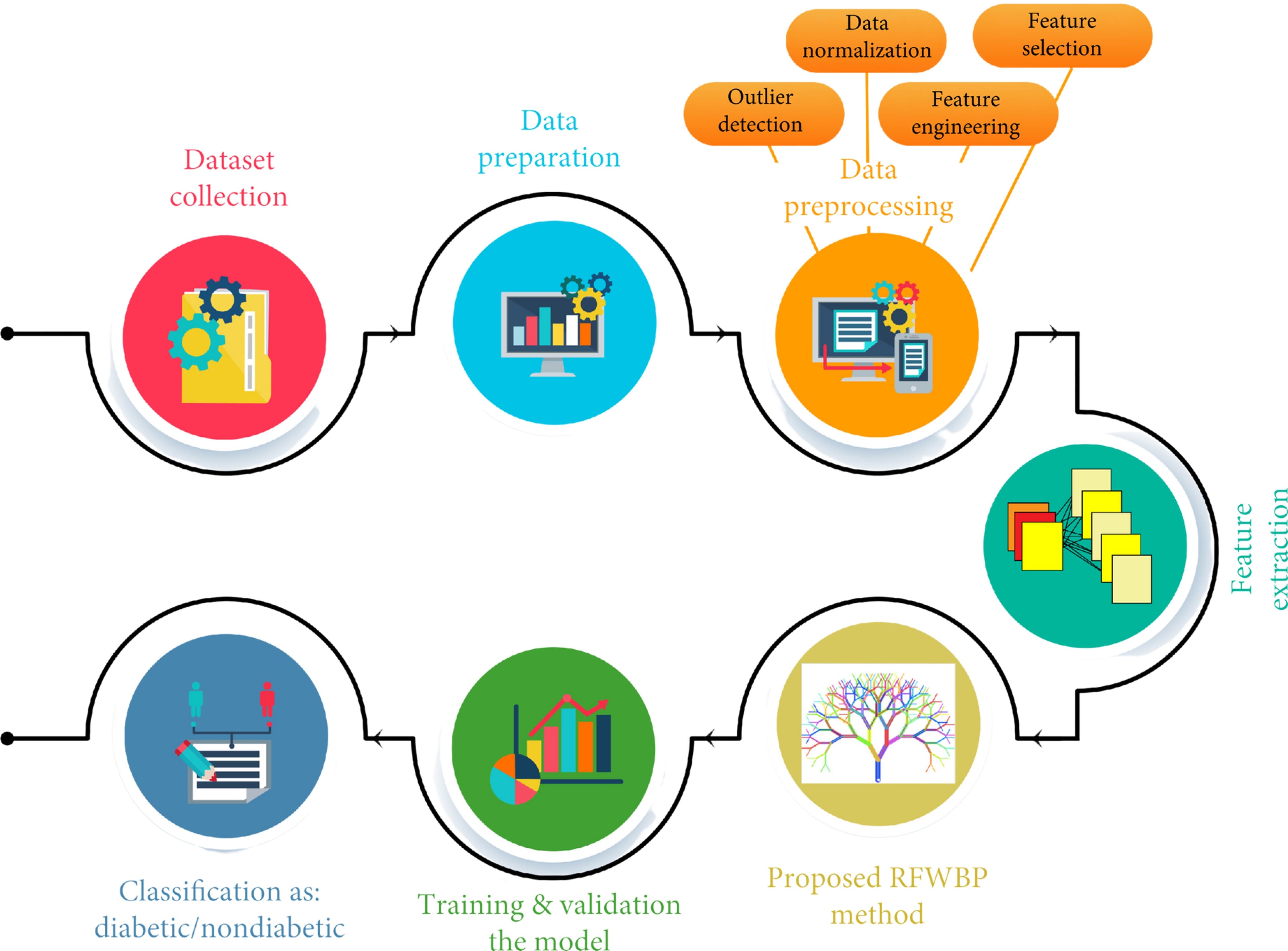
Steps Involved
1. Data Collection:
The first step in our workflow is data collection. We gather a variety of data points from different sources to build a comprehensive dataset for training our machine learning model. The types of data used include:
2. Data Preprocessing:
Once the data is collected, it undergoes preprocessing to ensure it is clean, consistent, and suitable for training the machine learning model. The preprocessing steps include:
Data Cleaning: Removing or correcting inaccurate, incomplete, or irrelevant data entries. This may involve handling missing values and eliminating duplicates.
Normalization: Scaling the data to ensure that all features contribute equally to the model training. This typically involves normalizing numeric values to a standard range.
Feature Engineering: Creating new features from existing data to enhance the model's predictive power. For example, calculating the ratio of certain health metrics.
Data Splitting: Dividing the dataset into training, validation, and test sets to evaluate the model's performance accurately.
3. Model Training:
In this step, we use the preprocessed data to train our machine learning model. The process involves:
Algorithm Selection: Choosing an appropriate machine learning algorithm suitable for the task. Common choices include decision trees, random forests, support vector machines, and neural networks.
Training the Model: Feeding the training data into the algorithm to learn patterns and relationships between the input features and the target variable (diabetes status).
Hyperparameter Tuning: Adjusting the model's parameters to optimize its performance. This is often done using techniques like cross-validation and grid search.
Model Evaluation: Assessing the model's performance using the validation set. Metrics such as accuracy, precision, recall, and F1-score are used to evaluate the results.
4. Prediction
Once the model is trained and validated, it is ready to make predictions. In this stage:
User Input: Users provide their health data through an intuitive web interface. The input data typically includes recent health metrics and lifestyle information.
Data Processing: The input data is preprocessed in real-time, applying the same normalization and feature engineering techniques used during model training.
Model Inference: The preprocessed data is fed into the trained model to generate a prediction. The model outputs a probability score indicating the risk of diabetes.
5. Result Interpretation:
The final step involves interpreting the prediction results and providing actionable insights to the users. This includes: